
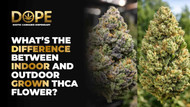
What’s the difference between indoor and outdoor grown THCA flower?
Mar 1st 2026
What’s the Difference Between Indoor and Outdoor Grown THCA Flower?
THCA flower can look similar on a menu, but how it’s grown changes the final product in ways customers notice immediately. Indoor cultivation emphasizes control, consistency, and top-shelf visuals. Outdoor cultivation emphasizes sun-grown expression, scalability, and value pricing. Greenhouse sits in the middle and often delivers the best “cost-to-quality” balance.
Just as importantly, the indoor vs. outdoor decision affects compliance risk. In U.S. hemp programs, legality is tied to testing rules that commonly measure “total THC” as Δ9 THC + (THCA × 0.877) on a dry-weight basis, which makes production strategy and harvest timing critical.
Understanding THCA Flower in 2026: Why “How It’s Grown” Matters More Than Ever
THCA is the acidic precursor to Delta-9 THC. When heat is applied, THCA converts into Delta-9 THC through decarboxylation. Because of that conversion, many buyers care about how loud the flower smokes, not just how it tests on paper.
In 2026, the regulatory environment also pushed brands to be more careful. Federal and state discussions increasingly focused on closing “intoxicating hemp” loopholes and tightening definitions. That created real-world uncertainty for high-THCA products, especially in stricter states and in situations where authorities look beyond marketing language and focus on lab math.
As a result, the best brands positioned indoor vs. outdoor flower as a quality tier and a risk-managed supply choice, not just a vibe.
Indoor Grown THCA Flower: What It Is
Indoor THCA flower is cultivated inside a controlled facility using artificial lighting and environmental systems. Growers can dial in temperature, humidity, airflow, CO₂, and light spectrum with precision. Because variables stay stable, indoor flower tends to be consistent from batch to batch.
Indoor is also where “designer bag appeal” comes from. Dense bud structure, loud aroma, and frosty trichome coverage are easier to repeat when the environment is engineered rather than weather-dependent.
Outdoor Grown THCA Flower: What It Is
Outdoor THCA flower is cultivated under natural sunlight in open fields. Sunlight provides a full spectrum that many growers and consumers describe as producing a “natural” expression of genetics. Outdoor also supports bigger plants and higher yields, which often lowers cost per gram.
Outdoor, however, is exposed to weather swings, pests, and environmental microbes. Because conditions change daily, outdoor flower usually shows more variation in bud density, aroma, and cannabinoid outcomes between harvests.
Indoor vs Outdoor THCA Flower: The Core Differences That Change the Product
1) Environmental Control vs Environmental Pressure
Indoor cultivation is built on control. Temperature and humidity targets reduce stress swings and create predictable growth. That predictability improves consistency in bud structure and testing.
Outdoor cultivation is shaped by environmental pressure. Wind, rain, heat, and daily light variation act like “natural stress tests.” That stress can increase variability, and it can also produce unique aroma nuances in some genetics.
2) Potency Outcomes: Why Indoor Often Tests Higher
Indoor flower often tests higher because growers can optimize photosynthesis drivers. Light intensity, photoperiod, CO₂ enrichment, and VPD targets can all be tuned to push cannabinoid expression.
Even when genetics are the same, indoor often produces higher headline numbers on lab reports. However, the practical smoking experience still depends on terpene preservation, curing quality, and freshness.
3) Terpene Profile: Loudness vs Complexity
Indoor flower often delivers “louder” top notes because delicate terpenes are better protected from heat spikes, rain, and UV degradation. Controlled drying also helps retain volatile compounds.
Outdoor flower can express a broader and sometimes more complex profile because full-spectrum sunlight and soil ecology influence secondary metabolites. Peer-reviewed comparisons have found meaningful differences between indoor and outdoor terpene profiles, which supports why the same cultivar can smell different depending on cultivation style.
4) Trichomes and Bag Appeal: Why Indoor Looks “Top Shelf”
Indoor cultivation typically produces tighter, denser buds with heavier trichome presence. That visual matters because most buyers make a quality judgment in the first two seconds of looking at the flower.
Outdoor flower can still be gorgeous, but it often presents as slightly airier. That difference is not always a “worse” outcome. It is simply a different outcome that reflects natural airflow, sun intensity, and seasonal conditions.
5) Consistency: Why Indoor Wins for Brand Reliability
Indoor cultivation is easier to standardize. Standardization makes it easier to keep SKU descriptions accurate, such as “gassy,” “sweet,” “citrus,” or “cake,” without surprises.
Outdoor cultivation is inherently more variable. Variation can be a feature for connoisseurs, but it can be a problem for a brand that promises the same experience every reorder.
Compliance and Testing in 2026: The Indoor vs Outdoor Risk Angle
Total THC math is the real issue, not marketing language
In many regulated hemp programs, testing uses a “total THC” calculation. That calculation commonly includes THCA multiplied by 0.877 plus Delta-9 THC.
This matters because high-THCA flower can fail a hemp threshold even if its Delta-9 number looks compliant. In plain terms, a flower can be “Δ9 compliant” but still be “total THC noncompliant” under certain testing frameworks.
Outdoor can introduce more testing variability
Outdoor crops face heat spikes, drought stress, and late-season swings. Those conditions can change cannabinoid development and create batch variance. That variance increases the odds that a portion of a field tests “hot,” especially if harvest timing is not dialed in.
Indoor can reduce variability but raises other scrutiny issues
Indoor crops can be managed to stay stable in the final weeks. That stability can help a grower hit a target window. However, high-THCA indoor flower can also be the most “marijuana-like” in appearance and effects, which may increase scrutiny in stricter jurisdictions.
In 2026, legal commentary and reporting tracked increased federal and state interest in restricting intoxicating hemp products. That trend made cultivation and documentation more important, including chain-of-custody, COAs, and defensible labeling.
Contaminants and Cleanliness: Where Each Method Has Different Risks
Outdoor risks: microbes, molds, and field exposure
Outdoor flower is exposed to rain, morning dew, soil splash, insects, and windblown spores. Those factors can increase the probability of microbial contamination if drying and storage are not flawless.
Research on cannabis and hemp cultivation highlights that microbial contamination and mycotoxin risk are real quality concerns, especially when plants encounter field pathogens.
Indoor risks: humidity mistakes and “room outbreaks”
Indoor cultivation is not automatically cleaner. Indoor rooms can develop mold outbreaks if humidity, airflow, or plant spacing is mismanaged. The difference is that indoor problems can spread fast across an entire room because everything shares the same air.
The best indoor operators treat drying and curing as a controlled process rather than an afterthought. Consistent cure conditions protect terpenes while preventing mold.
Flavor, Smoothness, and Customer Experience: What Buyers Actually Feel
Indoor often delivers sharper flavor and a “louder” nose
Indoor flower tends to carry sharper aroma intensity because the grow and cure are less weather-exposed. That leads to strong “jar pop” appeal and often better shelf presentation.
Outdoor can deliver a more “rounded” smoke in some genetics
Outdoor flower can feel more rounded when the cultivar responds well to natural sunlight. That is especially true when the farm nails harvest timing and slow curing. The best outdoor flower is not harsh. The best outdoor flower is simply different.
The cure matters more than the grow method
A perfect indoor grow can be ruined by a rushed dry. A well-run outdoor farm can beat indoor by curing slowly, keeping moisture stable, and storing properly. Because of that, cultivation method should be marketed as one quality signal, not the only one.
Sustainability and Cost: Why Indoor Is Premium and Outdoor Is Value
Indoor has higher energy inputs
Indoor cultivation uses lighting, HVAC, dehumidification, and often CO₂ enrichment. Energy intensity is one reason indoor flower costs more, even before trimming and packaging.
Published research has discussed indoor cannabis cultivation as energy-intensive compared to other cultivation models, including the role of controlled CO₂ and environmental systems.
Outdoor uses the sun as the main input
Outdoor relies on sunlight. That reduces energy costs and typically improves scalability. Lower overhead often translates into lower retail pricing, which is why outdoor can dominate “everyday flower” tiers.
Greenhouse can be the best of both worlds
Greenhouse flower uses sunlight while still offering partial control over humidity, pests, and temperature swings. Many brands use greenhouse to deliver near-indoor quality at a price point closer to outdoor.
Indoor vs Outdoor vs Greenhouse: How to Explain It on a Product Page
Indoor THCA flower positioning
Indoor is the “top shelf” tier. Indoor is for buyers who want maximum bag appeal, loud aroma, and consistent reorders. Indoor is easiest to justify with premium packaging and premium pricing.
Outdoor THCA flower positioning
Outdoor is the “sun-grown value” tier. Outdoor is for buyers who want affordable ounces, big buds, and a natural profile. Outdoor works well for budget lines and bulk shoppers.
Greenhouse THCA flower positioning
Greenhouse is the “best value premium” tier. Greenhouse is for buyers who want strong nose and potency at a mid-tier price. Greenhouse is also ideal when you want consistency without full indoor energy costs.
Buying Checklist: How Customers Can Tell Indoor vs Outdoor Quality Fast
Look at structure
Indoor buds are usually denser. Outdoor buds are often airier. However, great outdoor can still be sticky and resinous.
Smell for clarity
Indoor often has crisp top notes. Outdoor can have more earth and depth. A dull smell usually indicates age or poor storage rather than “outdoor.”
Ask for COAs and harvest info
COAs support potency and compliance claims. Harvest date matters because terpenes fade over time.
Check moisture and cure
A good cure feels springy, not wet. A good cure grinds fluffy, not dusty. A good cure tastes clean, not sharp or burnt.
Final Takeaway: Which One Should You Sell or Buy?
Indoor THCA flower is best when you want premium visuals, loud aroma, and consistent outcomes. Outdoor THCA flower is best when you want value pricing, big harvests, and sun-grown character. Greenhouse THCA flower is best when you want balance.
If you’re building a tiered lineup, the clean strategy is simple. Use indoor for “flagship strains.” Use greenhouse for “best value premium.” Use outdoor for “bulk and everyday pricing.” That structure makes your catalog easier to understand and improves conversion.